
PXe-AFV-P Programmable AC Power Source
PXe-AFV-P-0000
PX Electronics PXe-AFV-P Programmable AC Power Sources provide controlled, programmable AC voltage and frequency for product development, electrical validation, laboratory testing and automated production test systems.
Unlike a conventional variable AC supply, the AFV-P Series is designed for applications where engineers need to reproduce defined AC supply conditions repeatedly. Voltage, frequency, phase angle and test sequences can be programmed, while sweep, ramp and transient functions allow equipment to be tested against controlled changes in its electrical supply.
Four power ratings cover 600VA to 5kVA, with selectable AC output ranges of 0 to 155V RMS or 0 to 310V RMS. Standard frequency coverage is 40 to 500Hz, with an optional extended range of 15 to 1000Hz for aerospace and other specialist applications.
The AFV-P also provides programmable DC output, integrated electrical measurement, high peak-current capability, stored test sequences and a comprehensive set of remote-control interfaces. This makes it suitable for standalone laboratory use as well as integration into automated test equipment and production systems.
Technical Highlights for Programmable AC Power Testing
Programmable AC Control (Voltage, Frequency & Phase)
Set voltage and frequency directly, run sweep and ramp profiles, and control phase angle from 0° to 360° for repeatable AC test conditions and inrush analysis.
AC Disturbance & Transient Simulation
Generate sags, surges, spikes, dropouts and frequency changes with fast output response (≤300µs) for realistic supply disturbance and pre-compliance testing.
High Peak Current & Load Protection
Supports peak currents up to 4.5× RMS with constant-current foldback to handle inrush and overload conditions during device testing.
Automated Testing & Sequence Memory
Store up to 50 test memories and 1,200 steps, with remote control via RS232, RS485, Ethernet, USB and PLC I/O, plus optional GPIB and analogue interfaces.
Integrated Measurement & System Feedback
Built-in measurement of voltage, current, frequency, peak current and power provides real-time information during test operation.
Product Information
Programmable AC and DC Test Platform
The PXe-AFV-P combines a programmable AC source, a programmable DC output, and integrated measurement and test-sequence control within a single rack-compatible platform.
Four output ratings are available:
| Model | AC Rating | Maximum RMS Current | Maximum Peak Current |
|---|---|---|---|
| PX-AFV-P-600 | 600VA / 500W | 5A / 2.5A | 22.5A / 11.3A |
| PX-AFV-P-1250 | 1250VA / 1000W | 10A / 5A | 45A / 22.5A |
| PX-AFV-P-2500 | 2500VA / 2000W | 20A / 10A | 90A / 45A |
| PX-AFV-P-5000 | 5000VA / 4000W | 40A / 20A | 180A / 90A |
Current values are shown for the 0-155V / 0-310V ranges, respectively.
Selectable AC Voltage Ranges
Two programmable AC voltage ranges are available:
0 to 155V RMS
0 to 310V RMS
The range is user-selectable, and voltage setting resolution is 0.1V RMS.
The lower voltage range provides the higher available output current. The 310V range provides greater voltage capability with a correspondingly lower maximum current.
The required voltage range and load current should therefore be considered together when selecting the correct AFV-P rating.
Frequency Configuration
Standard programmable output frequency is:
40 to 500Hz
An extended-frequency option provides:
15 to 1000Hz
The standard range covers conventional 50Hz and 60Hz testing, as well as 400Hz testing for aerospace and specialist electrical equipment.
The extended-frequency option is intended for cases where operation below 40Hz or above 500Hz is part of the required test procedure.
Sweep and Ramp Testing
The Sweep function allows voltage or frequency to change automatically between programmed operating points.
It can be used for:
- Voltage operating-window testing
- Minimum and maximum supply-voltage evaluation
- Frequency tolerance testing
- Repetitive product validation
- Automated production testing
Changes can be programmed as individual steps or continuous sequences.
The Ramp function controls the rate at which voltage or frequency changes. A controlled voltage ramp can also be useful when energising motors and other loads with substantial starting current.
AC Disturbance and Transient Generation
The AFV-P can create controlled power-line disturbances without relying on variations in the available site mains supply.
Programmable events include:
- Voltage sag
- Voltage surge
- Spike
- Dropout
- Rapid voltage change
- Frequency change
These functions are useful during product development, fault investigation, and pre-compliance work, where engineers need to understand how equipment behaves when its supply deviates from normal operating conditions.
The output voltage can move from 0% to 90% within 300 µs, providing the response required for fast disturbance testing.
The AFV-P is best described as a programmable AC source for controlled supply simulation and pre-compliance investigation rather than a full regenerative grid simulator.
Start and End Phase-Angle Control
Output start and end phase angles can be programmed from 0° to 360°.
The point on the AC waveform at which a load is energised can significantly affect its initial current. Phase-angle control therefore allows switch-on behaviour to be reproduced under defined conditions rather than relying on a random point in the mains cycle.
This is particularly useful with:
- Transformers
- Motors
- Switching power supplies
- Rectifier-fed loads
- Capacitive input circuits
- Equipment with significant charging current
- High Peak-Current Capability
Peak output capability is up to 4.5 times the maximum RMS output current.
This allows the source to support short-duration current demand from equipment whose initial current is substantially greater than its normal operating current.
Model selection should still consider the magnitude, duration and repetition of the inrush event as well as the continuous RMS load.
Stored Test Sequences
The AFV-P provides:
- 50 test memories
- 24 programmable steps per memory
- 1,200 total programmable steps
Frequently used test sequences can therefore be stored and repeated without manually entering each voltage, frequency or timing condition.
This is particularly useful for quality control, production testing, and repeatable design validation procedures.
Programmable DC Output
The AFV-P also provides programmable DC output, extending the platform’s capabilities to DC testing where required.
| Model | DC Power | Voltage Range | Maximum Current |
|---|---|---|---|
| PX-AFV-P-600 | 300W | 0 to 210V / 0 to 420V | 2.5A / 1.25A |
| PX-AFV-P-1250 | 600W | 0 to 210V / 0 to 420V | 5A / 2.5A |
| PX-AFV-P-2500 | 1250W | 0 to 210V / 0 to 420V | 10A / 5A |
| PX-AFV-P-5000 | 2500W | 0 to 210V / 0 to 420V | 20A / 10A |
The DC capability is a useful secondary function, but the product should remain positioned primarily as a Programmable AC Power Source.
Integrated Measurement
The AFV-P incorporates measurement functions to enable direct monitoring of key electrical parameters from the power source.
Available measurements include:
- RMS voltage
- RMS current
- Peak current
- Output frequency
- True power
- Apparent power
- Reactive power
- Power factor
- Crest factor
The 4.3-inch touchscreen provides local measurement and operating information together with direct access to test parameters.
For applications requiring higher measurement accuracy, harmonic analysis or traceable power measurement, a separate precision power analyser can be used alongside the AFV-P.
Front-Panel Control
Local operation is provided through the 4.3-inch touchscreen and rotary control.
The operator can set and review:
- Output voltage
- Output frequency
- Current limits
- Output state
- Test sequences
- Measurements
- Stored programmes
The rotary control provides precise adjustment, while the touchscreen provides direct access to operating parameters and measurement information.
Remote Sense
Remote-sense connections compensate for voltage drop between the power source and the equipment under test.
This can be useful where cable resistance would otherwise cause the device under test to experience a voltage different from the programmed source voltage.
Remote Control and Automated Test Integration
Standard remote interfaces include:
- Ethernet
- USB
- RS232
- RS485
- PLC Remote Input/Output
Optional interfaces include:
- GPIB
- Analogue control
Control software and a LabVIEW driver are available to support remote setup, sequence control, data collection, and integration with automated test equipment.
Constant-Current Foldback
The AFV-P includes Over-Current Foldback with Constant-Current operation.
Where the connected load attempts to draw more than the programmed current, the source can reduce output voltage while maintaining the controlled current limit.
This provides a useful operating mode for development work and for loads where the current behaviour needs to be controlled rather than immediately shutting down the source.
Output Synchronisation Signal
A 5V BNC synchronisation output provides an event signal for:
Output ON
Programmed voltage change
Programmed frequency change
This can be used to trigger or synchronise oscilloscopes, data-acquisition equipment and other instruments with the programmed AFV-P test event.
Selecting the Correct PXe-AFV-P
The AFV-P should be selected around the complete test requirement rather than simply matching its VA rating to the nameplate rating of the equipment under test.
PX normally reviews:
- Continuous VA and W
- Required AC voltage range
- Maximum RMS current
- Peak and inrush current
- Frequency range
- Load type
- Required disturbance functions
- AC and DC testing requirements
- Remote-control interface
- Automation requirements
- Calibration and documentation
| Requirement | Information to Provide |
|---|---|
| Continuous Load | Required VA and W at the normal operating point. |
| AC Voltage | Minimum, nominal and maximum voltage required during testing. |
| RMS Current | Maximum continuous current required at the selected output voltage. |
| Peak / Inrush Current | Known starting, charging or short-duration current demand. |
| Frequency | Required minimum and maximum frequency, including whether operation outside 40 to 500Hz is needed. |
| Load Type | Electronic, motor, transformer, rectifier, capacitive, appliance or other load. |
| Test Functions | Fixed output, sweep, ramp, sag, surge, dropout, phase-angle or stored sequence requirements. |
| DC Output | Required DC voltage, current and power where DC testing will also be used. |
| Remote Control | PC, PLC, Ethernet, serial, GPIB or analogue-control requirement. |
| Documentation | Required calibration, test documentation or project-specific reporting. |
Available Models
PX-AFV-P-600
600VA / 500W model for lower-power laboratory, development and component testing.
PX-AFV-P-1250
1250VA / 1000W model for laboratory, R&D, product validation and production testing requiring increased continuous and peak current.
PX-AFV-P-2500
2500VA / 2000W model for higher-power equipment testing and automated test systems.
PX-AFV-P-5000
5000VA / 4000W model with up to 40A RMS output on the lower AC voltage range and up to 180A peak-current capability.
Input Supply
| Model | Input Voltage | Maximum Input Current |
|---|---|---|
| PX-AFV-P-600 | 98 to 132V AC / 196 to 264V AC | 10A |
| PX-AFV-P-1250 | 98 to 132V AC / 196 to 264V AC | 20A |
| PX-AFV-P-2500 | 196 to 264V AC or 175 to 235V AC | 20A |
| PX-AFV-P-5000 | 196 to 264V AC or 175 to 235V AC | 40A |
All models use a single-phase input with a published input frequency range of 47 to 63Hz.
Extended Frequency Option
Standard frequency coverage is:
40 to 500Hz
Optional extended frequency:
15 to 1000Hz
Specify the extended-frequency option where the test programme requires output above 500Hz or below 40Hz.
Remote Interface Options
Standard
- RS232
- RS485
- Ethernet
- USB
- PLC Remote Input/Output
Optional
- GPIB
- Analogue control
The required control interface should be identified when the system is specified, particularly where the AFV-P will form part of an existing automated test platform.
Test Automation
For automated applications, confirm:
- Required communication interface
- Test-sequence structure
- Trigger requirements
- External instrument synchronisation
- Required measurement collection
- PLC integration
- LabVIEW integration
- Reporting requirements
Defining these requirements early avoids unnecessary interface changes once the test system has been assembled.
Calibration and Documentation
Where required, PX can provide project-specific test and calibration documentation appropriate to the supplied configuration.
For applications where the AFV-P forms part of a formal measurement or compliance system, the required measurement uncertainty and external reference instrumentation should be identified before quotation.
Mechanical Configuration
The AFV-P uses a rack-compatible 442mm-wide chassis.
| Model | Dimensions H × W × D | Approx. Weight |
|---|---|---|
| PX-AFV-P-600 | 89 × 442 × 450mm | 16kg |
| PX-AFV-P-1250 | 89 × 442 × 600mm | 20kg |
| PX-AFV-P-2500 | 89 × 442 × 600mm | 31.3kg |
| PX-AFV-P-5000 | 222.5 × 442 × 600mm | 70kg |
Allow sufficient clearance for ventilation, mains and output cabling, remote-sense connections and communication interfaces.
PXe-AFV-P Series Technical Specification
Input
| Parameter | AFV-P-600 | AFV-P-1250 | AFV-P-2500 | AFV-P-5000 |
|---|---|---|---|---|
| Phase | Single phase | Single phase | Single phase | Single phase |
| Input Voltage | 98-132 / 196-264V AC | 98-132 / 196-264V AC | 196-264V AC or 175-235V AC | 196-264V AC or 175-235V AC |
| Input Frequency | 47-63Hz | 47-63Hz | 47-63Hz | 47-63Hz |
| Maximum Input Current | 10A | 20A | 20A | 40A |
AC Output
| Parameter | AFV-P-600 | AFV-P-1250 | AFV-P-2500 | AFV-P-5000 |
|---|---|---|---|---|
| Rated Power | 600VA / 500W | 1250VA / 1000W | 2500VA / 2000W | 5000VA / 4000W |
| Output Arrangement | Single phase, 2-wire + earth | Single phase, 2-wire + earth | Single phase, 2-wire + earth | Single phase, 2-wire + earth |
| Voltage Ranges | 0-155 / 0-310V RMS | 0-155 / 0-310V RMS | 0-155 / 0-310V RMS | 0-155 / 0-310V RMS |
| Voltage Resolution | 0.1V RMS | 0.1V RMS | 0.1V RMS | 0.1V RMS |
| Frequency Range | 40-500Hz; option 15-1000Hz | 40-500Hz; option 15-1000Hz | 40-500Hz; option 15-1000Hz | 40-500Hz; option 15-1000Hz |
| Frequency Resolution | 0.1Hz; 1Hz above 100Hz | 0.1Hz; 1Hz above 100Hz | 0.1Hz; 1Hz above 100Hz | 0.1Hz; 1Hz above 100Hz |
| Maximum RMS Current | 5A / 2.5A | 10A / 5A | 20A / 10A | 40A / 20A |
| Maximum Peak Current | 22.5A / 11.3A | 45A / 22.5A | 90A / 45A | 180A / 90A |
| THD, Resistive Load | ≤0.3% at 40-100Hz; ≤0.5% at 101-500Hz; ≤0.8% at 501-1000Hz | |||
| Line Regulation | ±0.1V | |||
| Load Regulation | ≤0.07% FS, resistive load | |||
| Response Time | ≤300µs | |||
| Crest Factor | ≥3 | |||
| Peak / Inrush Capability | Up to 4.5 × maximum RMS output current | |||
DC Output
| Parameter | AFV-P-600 | AFV-P-1250 | AFV-P-2500 | AFV-P-5000 |
|---|---|---|---|---|
| Rated DC Power | 300W | 600W | 1250W | 2500W |
| Voltage Ranges | 0-210 / 0-420V | 0-210 / 0-420V | 0-210 / 0-420V | 0-210 / 0-420V |
| Maximum Current | 2.5A / 1.25A | 5A / 2.5A | 10A / 5A | 20A / 10A |
| Ripple & Noise, RMS | ≤0.15% | ≤0.15% | ≤0.15% | ≤0.24% |
Measurement
| Measurement | Specification |
|---|---|
| Voltage Range | 0-420V RMS |
| Voltage Accuracy | ±(0.2% of reading + 5 counts) |
| Voltage Resolution | 0.1V |
| Frequency Range | 15-1000Hz |
| Frequency Accuracy | ±0.1Hz at 40-500Hz; ±0.2Hz at 501-1000Hz |
| Frequency Resolution | 0.1Hz |
| Current Accuracy | ±(1% of reading + 5 counts) at 40-500Hz; ±(1% of reading + 10 counts) at 501-1000Hz |
| Peak Current Accuracy | ±(1% of reading + 5 counts) at 40-500Hz; ±(1% of reading + 10 counts) at 501-1000Hz |
| Peak Current Resolution | 0.1A |
| Power Accuracy | ±(2% of reading + 10 counts) at 40-500Hz; ±(2% of reading + 15 counts) at 501-1000Hz |
General
| Parameter | Specification |
|---|---|
| Efficiency | ≥80% at maximum power |
| Protection | OVP, OCP, LVP, OPP, OTP, RCP and fan-failure protection |
| Remote Interfaces | Standard: RS232, RS485, Ethernet, USB and PLC Remote I/O. Optional: GPIB and analogue control |
| Over-Current Foldback | CC mode, Constant Current |
| Output Synchronisation | 5V BNC signal for Output ON and voltage/frequency change events |
| Memories | 50 memories, 1,200 steps, 24 steps per memory |
| Operating Temperature | 0°C to 40°C |
Dimensions and Weight
| Model | Dimensions H × W × D | Approx. Weight |
|---|---|---|
| AFV-P-600 | 89 × 442 × 450mm | 16kg |
| AFV-P-1250 | 89 × 442 × 600mm | 20kg |
| AFV-P-2500 | 89 × 442 × 600mm | 31.3kg |
| AFV-P-5000 | 222.5 × 442 × 600mm | 70kg |
Specification note: Specifications are preliminary. Final configuration and guaranteed performance should be confirmed at quotation. Output values shown as low-voltage range / high-voltage range where applicable.
No matching FAQs found.
A programmable AC power source is used to simulate different electrical grid conditions during product testing, validation and troubleshooting. Engineers commonly use these systems to test electronics, appliances, motors and industrial equipment under controlled voltage and frequency conditions.
Depending on the model configuration, programmable AC power sources can be used to simulate voltage fluctuations, frequency variations and abnormal power conditions for product testing.
A standard AC power supply typically provides fixed output, while a programmable AC power source allows engineers to adjust voltage, frequency and output parameters to simulate real-world operating conditions for testing and development.
Yes. Programmable AC sources are commonly used to simulate both 50Hz and 60Hz power conditions for products being sold into different international markets.
Yes. Optional communication interfaces allow integration into automated testing systems and production environments where repeatable testing is required.
Common applications include power supplies, motors, household appliances, aerospace equipment, industrial controls, EV components and electronic products.
Yes. Many engineers use programmable AC power sources for compliance testing, product certification and export validation where products must perform under different regional power standards.
Variable AC power sources are widely used in aerospace, electronics manufacturing, appliance testing, automotive development, renewable energy testing and industrial product validation.
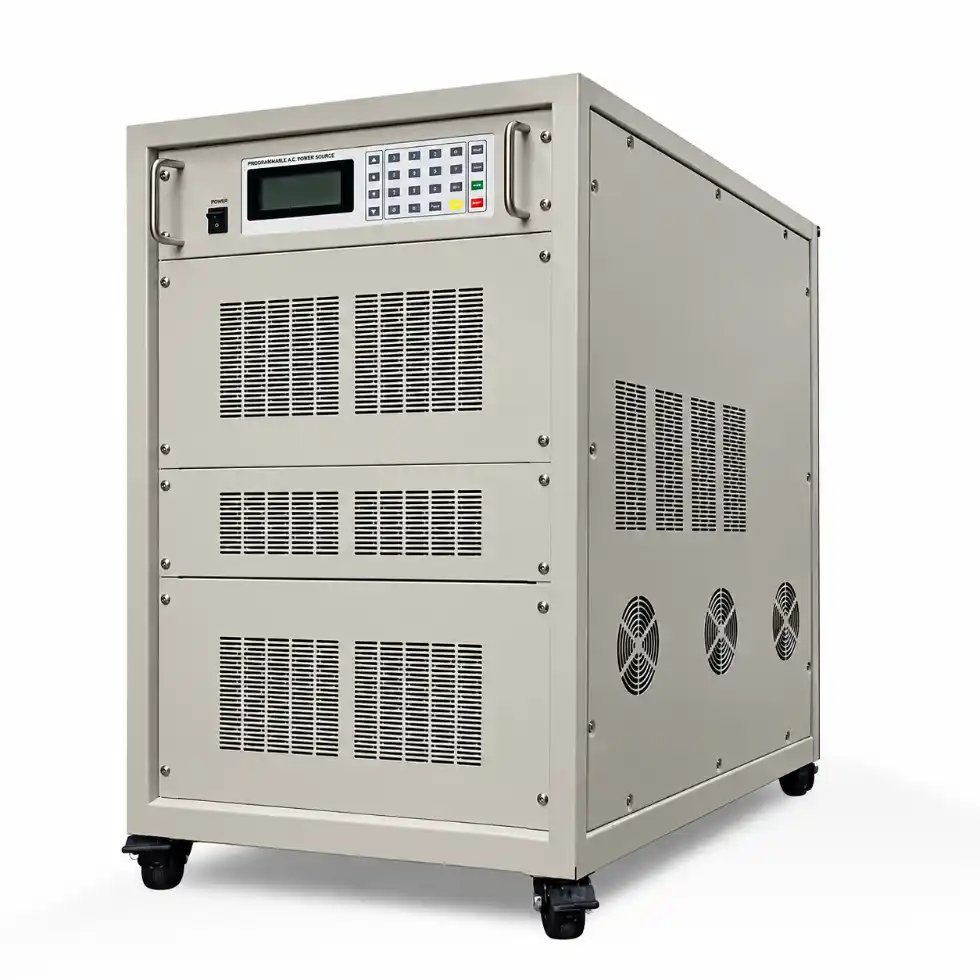
PXe-270DC Series 270Vdc Aircraft Power Supplies
PXe-270DC-000
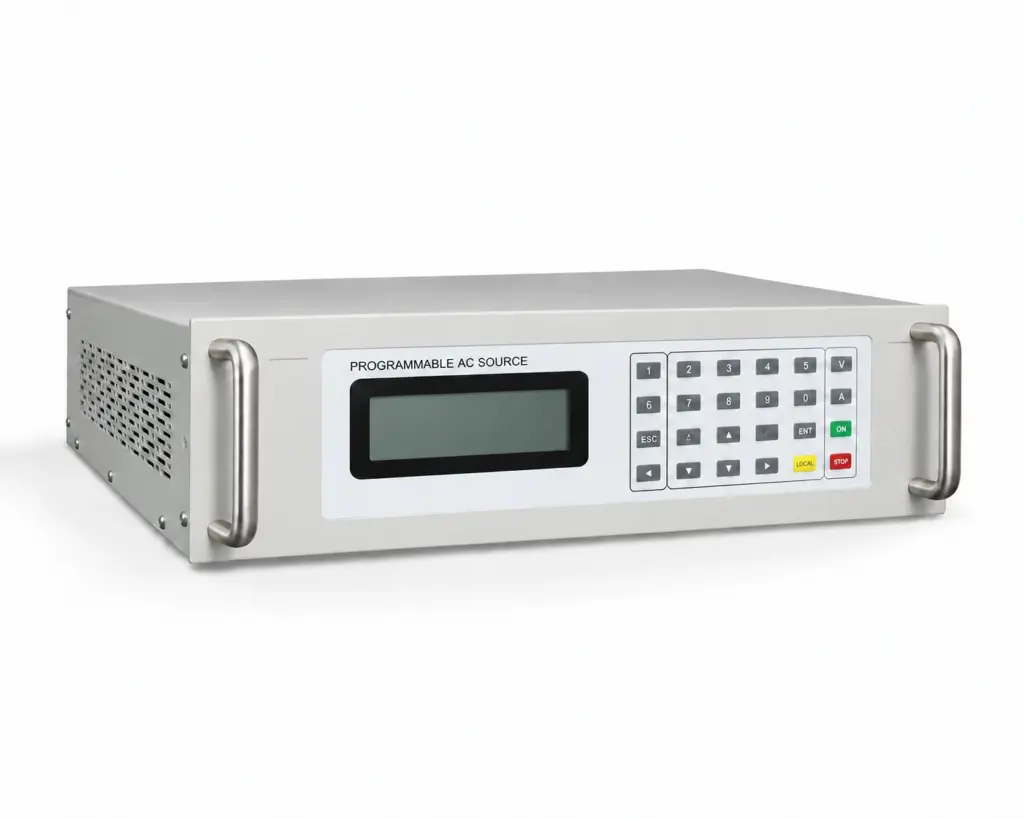
PXe-A Series Variable AC Power Supplies
PXe-130000-A
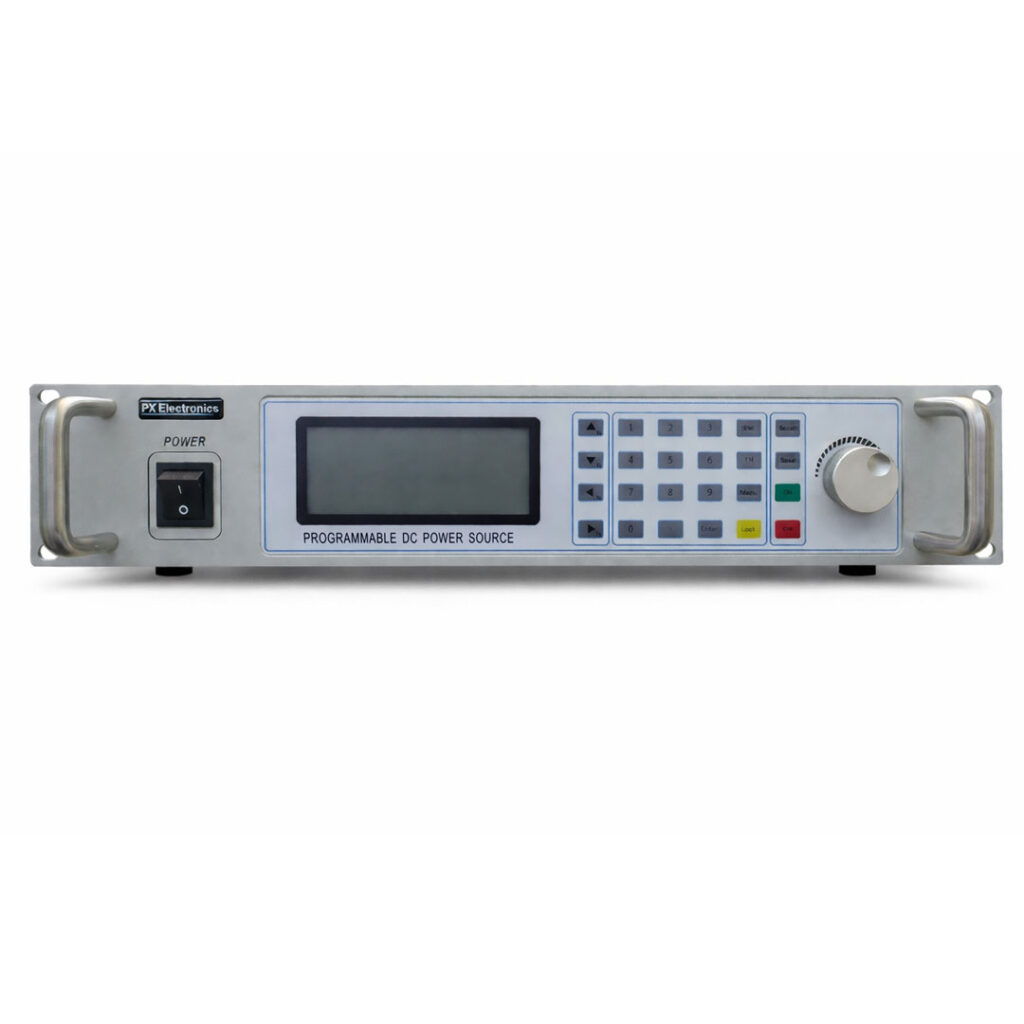
PXe-AC/DC Series AC-DC & DC-AC Static Power Converters
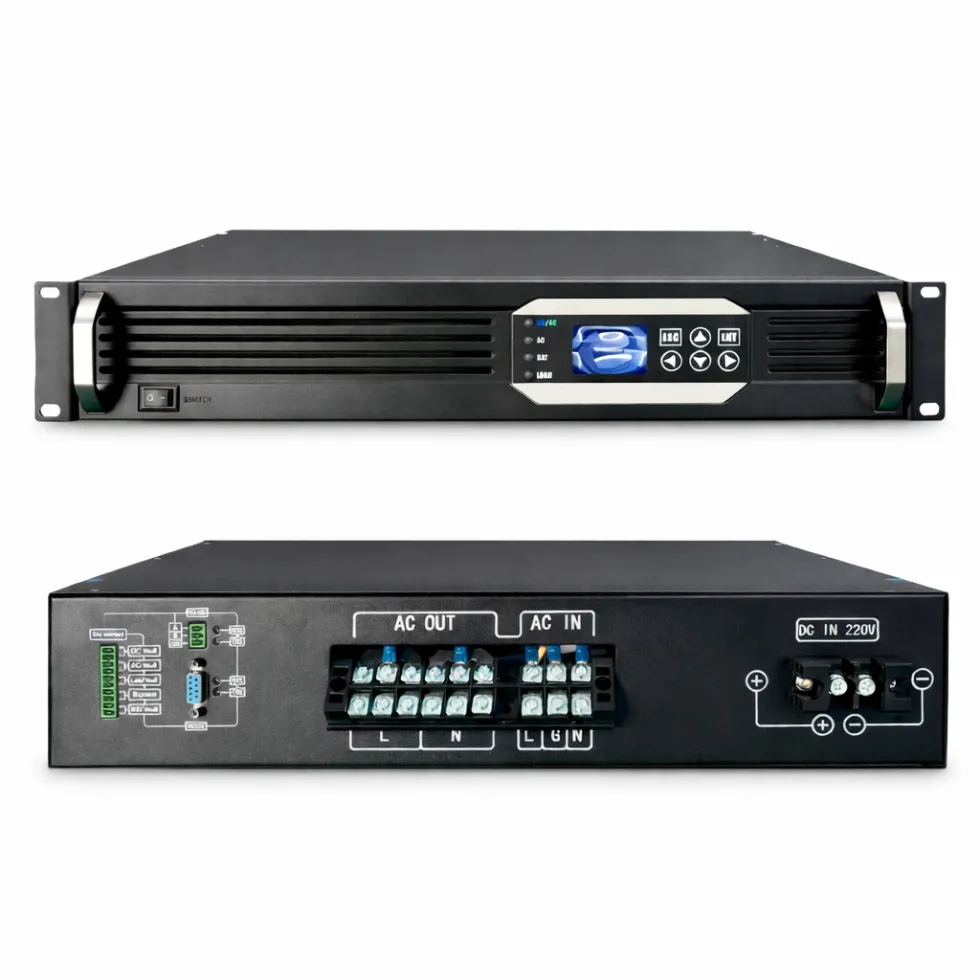
PXe-BLS Dual Redundant AC Power Supplies
PXe-BLS-00
PXe-D Series Programmable DC Power Supplies
PXe-D-00-000 Series
PXe-LC Series AC High Current Calibrator
PXe-110001.2LC