Static Frequency Converter Remote Monitoring Watchdog
PLC-Based Monitoring for Static Frequency Converters
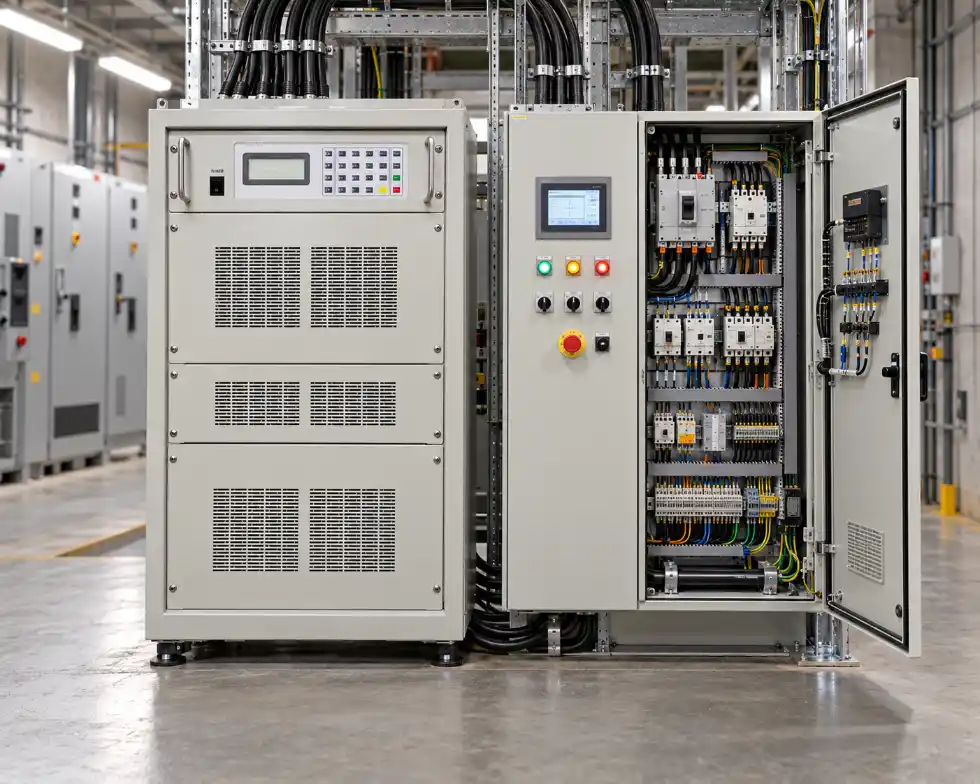
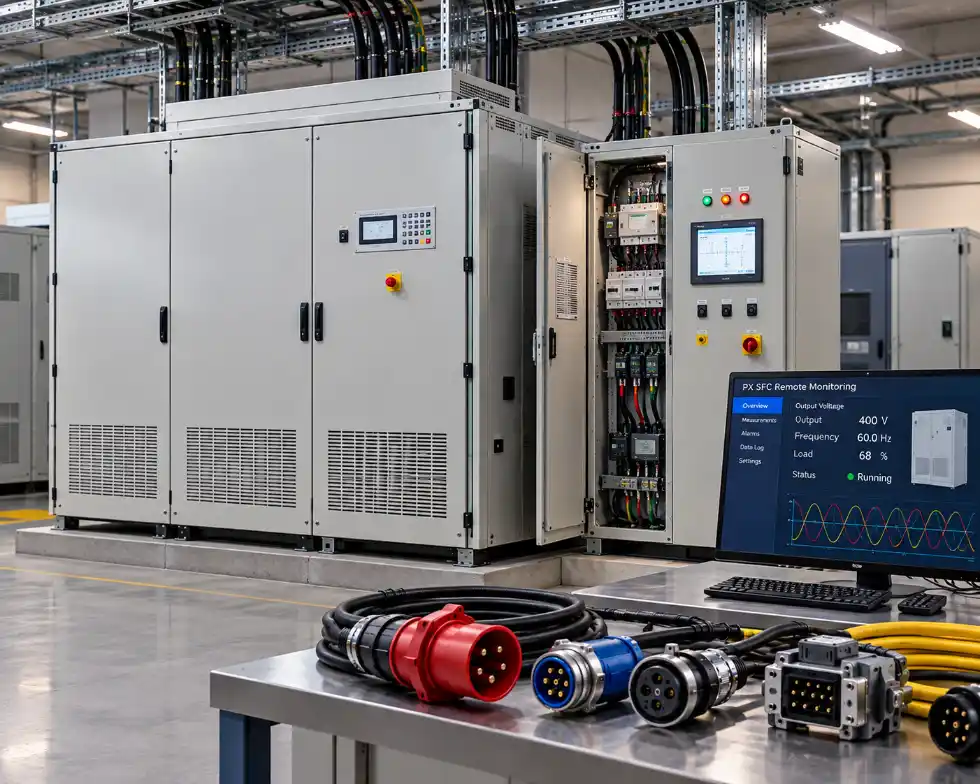
The PX Electronics SFC Remote Watchdog provides independent PLC-based supervision for Static Frequency Converters installed in remote, unattended or operationally important locations.
The system monitors selected electrical and operational signals from the SFC, records alarms and operating events, and can send fault notifications to nominated personnel. Depending on the project, it can also provide remote status access, controlled start and stop commands, fault reset and automatic restart following approved recoverable conditions.
SFC Remote Watchdog monitoring is typically specified for converters above 50kVA, although it can also be applied to smaller systems where the load is critical, the installation is difficult to access or early fault visibility is required.
The watchdog is supplied as part of the overall SFC control and monitoring arrangement. It supports the converter’s existing protection system but does not replace circuit protection, internal trips, emergency stops or site safety controls.
Product Information
SFC Monitoring and Alarm Configuration
The SFC Remote Watchdog is configured around the converter, connected load, required monitoring points and the action to be taken when an alarm or fault occurs.
The final signal list depends on the SFC model and the information available from its controller, meters, protective devices and external sensors.
Typical Monitored Signals
| Monitoring Group | Typical Signals |
|---|---|
| SFC Operating State | Available, ready, running, stopped, warning, fault and emergency stop status |
| Input Supply | Input available, input voltage condition, phase status, phase loss and protective device state |
| Output Supply | Output voltage, current, frequency, power, phase condition and output available status |
| Converter Conditions | Over-temperature, overload, over-voltage, under-voltage, short circuit and internal converter fault |
| Cooling System | Fan operation, cooling warning, airflow condition or enclosure temperature where sensors are fitted |
| Switchgear and Interlocks | Breaker position, contactor state, door interlock, external permissive and emergency stop circuit |
| Communications | SFC communication health, watchdog heartbeat, network availability and remote connection status |
Only the signals required for the project need to be included. Additional analogue and digital inputs can be added where external temperature sensors, airflow switches, protective devices or site interlocks need to be monitored.
Alarm and Event Handling
The watchdog can classify events according to their operational significance.
A warning may indicate a condition that requires attention but does not immediately stop the SFC. A fault or trip indicates that the converter has shut down or that operation should not continue. Communication-loss alarms can identify when the monitoring controller no longer receives a valid heartbeat or status update.
Event records can include:
- Date and time
- SFC operating state
- Alarm or fault description
- Measured values where available
- Remote or local command activity
- Alarm acknowledgement
- Reset attempts
- Automatic restart attempts
- Communications loss and restoration
The amount of stored history and the method for downloading or viewing records depend on the selected controller and communication package.
Automatic Restart Logic
Automatic restart is project-specific and should be enabled only for agreed-upon recoverable events.
A typical restart sequence may require:
- The input supply to have returned and remained stable for a defined period
- No emergency stop or external interlock to be active
- No over-temperature, short-circuit or other manual-reset fault to remain
- The connected load to be permitted to restart automatically
- Remote restart to be enabled by the authorised operator
- The configured restart delay to have expired
The watchdog can apply a maximum number of restart attempts. If the SFC fails repeatedly, the system can enter a lockout state and require manual inspection or an authorised reset.
Safety-related trips, emergency stops, repeated overloads, short circuits and abnormal temperature conditions should not normally initiate an automatic restart without investigation.
Specifying an SFC Remote Watchdog
The monitoring system must be configured around the SFC control signals, site communications and the customer’s required response to each alarm condition.
Information Required
| Requirement | Information to Provide |
|---|---|
| SFC Details | Converter model, capacity, input supply, output voltage, output frequency and phase arrangement |
| Monitoring Points | Required electrical values, operating states, warnings, faults, switchgear positions and external sensors |
| Alarm Response | Which conditions require notification, shutdown, acknowledgement, manual reset or automatic recovery |
| Remote Notifications | SMS recipients, escalation requirements and any network-based notification method |
| Remote Commands | Status-only access or permission for start, stop, acknowledge, reset and restart commands |
| Restart Policy | Permitted restart conditions, delay time, maximum attempts, lockout behaviour and manual-reset faults |
| Communication | Ethernet, RS485, Modbus RTU, Modbus TCP, volt-free contacts or integration with PLC, SCADA or BMS |
| Site Connectivity | Mobile network coverage, SIM responsibility, Ethernet connection, firewall, VPN and site IT requirements |
| Installation | Integrated or separate enclosure, IP rating, auxiliary supply, cable entry and environmental conditions |
| Documentation | I/O schedule, alarm matrix, cause-and-effect logic, FAT records, operating instructions and commissioning support |
Available Options
SMS Fault Notification
A cellular communication module can send alarm and fault messages to nominated telephone numbers. Site mobile coverage and SIM arrangements must be confirmed before supply.
Ethernet and Network Monitoring
Ethernet connectivity can be provided for local network access, remote status or connection to a wider monitoring system.
RS485 and Modbus Integration
RS485 with Modbus RTU or Ethernet with Modbus TCP can be used to exchange status, alarm and measurement data with PLC, SCADA or BMS systems.
Volt-Free Alarm Contacts
Dedicated relay contacts can provide simple run, warning, common alarm or fault outputs without requiring a data-network connection.
Remote HMI or Status Display
A local or remote HMI can show system state, active alarms, measured values, event history and authorised controls.
Additional Monitoring Inputs
Extra digital or analogue inputs can be provided for external temperature sensors, airflow switches, room alarms, breaker contacts, door switches or customer-defined interlocks.
Automatic Restart Package
Configurable restart delay, retry count and lockout logic can be added where the connected process is suitable for unattended restart.
Independent Auxiliary Supply
A separate auxiliary supply or customer-backed control supply can be specified where monitoring must remain active during loss of the main SFC input.
Alarm Escalation
Different recipients or outputs can be assigned to warning, fault and communications-loss conditions, subject to the selected monitoring platform.
Integrated or Separate Enclosure
The watchdog can be incorporated into the SFC control enclosure or supplied in a separate panel where space, retrofit access or environmental requirements make this preferable.
IP32 or IP54 Enclosure
Higher enclosure protection is available where the watchdog panel is installed in dusty, damp or exposed industrial environments.
Factory Acceptance Testing
The alarm matrix, monitored signals, remote messages and approved restart sequences can be demonstrated during FAT.
Site Commissioning
On-site commissioning can include signal verification, communications testing, alarm simulation, recipient confirmation and controlled restart testing.
Typical SFC Remote Watchdog Specification
The final specification is prepared for the individual SFC and site requirements.
| Specification | Typical Configuration |
|---|---|
| Application | Independent supervisory monitoring of PX Static Frequency Converter systems |
| Recommended Use | Typically SFCs above 50kVA, remote installations and critical-load applications |
| Controller | Industrial PLC or project-specific monitoring controller |
| Monitoring Inputs | Digital, analogue and communication-derived signals according to the SFC and project I/O schedule |
| Typical Measurements | Voltage, current, frequency and power where suitable measurement signals are available |
| Typical Status Monitoring | Available, ready, run, warning, fault, phase loss, overtemperature, breaker state and communications health |
| Event History | Time-stamped non-volatile alarm, fault, command, reset and restart records |
| Remote Notification | SMS as a common option, with network-based notification available according to the selected platform |
| Remote Commands | Start, stop, acknowledge and reset where permitted by the agreed control philosophy and interlocks |
| Automatic Restart | Optional, with configurable permissives, delay, retry limit and lockout logic |
| Communication Options | RS485, Ethernet, Modbus RTU, Modbus TCP, volt-free contacts and project-specific interfaces |
| Local Interface | Status indication or optional HMI, depending on the selected system |
| Installation | Integrated into the SFC or supplied as a separate monitoring enclosure |
| Enclosure | Selected to suit the installation, with IP22, IP32 and IP54 arrangements available |
| Compatibility | New PX SFC systems or retrofit applications subject to signal availability and technical review |
| Documentation | Signal schedule, alarm matrix, control description, drawings and test records as agreed |
Important: The standard SFC Remote Watchdog is a monitoring and supervisory control option. It should not be described as a SIL-rated or safety-certified system unless the complete project design has been assessed and certified for the required safety function.
No matching FAQs found.
An SFC Remote Watchdog is an independent PLC-based monitoring system that supervises the operating condition of a Static Frequency Converter.
It can record alarms, send remote notifications and provide selected remote-control functions.
It is typically recommended for SFCs above 50kVA, unattended installations, remote sites and systems supporting important operational loads.
It may also be worthwhile on smaller converters where access is difficult or early fault notification is important.
Depending on the available signals, it can monitor input and output voltage, output current, frequency, power, phase loss, run status, warnings, trips, temperature, fan operation, breaker position and communications health.
PX Electronics will require:
- SFC model and rating
- Input and output electrical details
- Required monitored values and status signals
- Required alarms and notification recipients
- Remote-control requirements
- Automatic restart policy
- Communication protocol
- Site network or mobile connectivity
- Installation and enclosure requirements
- Required drawings, testing and commissioning support
The SFC’s internal protection acts directly on the converter to respond to conditions such as overload, overtemperature, overvoltage or short circuit.
The watchdog supervises the wider operating state, records events and communicates status remotely. It supports the internal protection system but does not replace it.
The standard watchdog is a supervisory monitoring and control system. It is not automatically a safety-rated or SIL-certified system.
Where a certified safety function is required, the complete control architecture, components, logic and validation must be designed and assessed accordingly.
Yes. Event history can record time-stamped alarms, faults, operating changes, remote commands, resets and restart attempts.
The storage capacity and download method depend on the selected controller.
Yes. Integration can be provided using Modbus, Ethernet, RS485, volt-free contacts or project-specific interfaces.
The required register map, alarm list and control permissions should be agreed before manufacture.
Remote start, stop, acknowledge and reset functions can be provided where they are appropriate for the connected load and site control philosophy.
Local safety interlocks and emergency controls remain effective during remote operation.
Yes, for approved recoverable conditions.
Restart logic should confirm that the supply is stable, no manual-reset fault remains, safety interlocks are healthy and the connected equipment is suitable for automatic restart.
Emergency-stop operation, short circuit, repeated overload, abnormal temperature and faults indicating possible equipment damage should normally require inspection or manual reset.
The final cause-and-effect logic is agreed for each project.
Yes. SMS notification can be provided using a suitable cellular communication module.
The customer must confirm mobile coverage, recipient details and responsibility for the SIM and data service.
Yes. The watchdog can supervise 50Hz, 60Hz and 400Hz SFC installations.
The monitoring inputs and alarm thresholds are configured around the actual converter output.
Not in every configuration. Local PLC, volt-free contact and RS485 monitoring can operate without an internet connection.
SMS or remote network access requires the relevant cellular or site-network connection.
The SFC and watchdog continue to follow their local control and protection logic. Loss of communications can itself be recorded as an alarm.
Remote visibility and commands will remain unavailable until the connection is restored.
Potentially. Retrofit suitability depends on the existing SFC control system, available signals, panel space, communications and whether remote commands can be added safely.
A technical review is required before a retrofit is offered.
No. Remote monitoring can identify faults and operating trends, but it does not replace routine inspection, cleaning, connection checks, fan checks or planned servicing.