Static Frequency Converter Options and Accessories
PX Electronics supplies options and accessories to adapt a Static Frequency Converter to the available input supply, connected load, installation environment and operating requirements.
Options can include alternative input and output arrangements, industrial or application-specific connectors, higher enclosure protection, conformal coating, communication interfaces, remote monitoring, mobile construction and aviation-specific cable systems.
These requirements should ideally be identified before manufacture. Connector arrangements, enclosure ratings, transformer configuration, cooling and cable entry can affect the physical construction of the SFC and may be difficult to change after delivery. Current PX SFC platforms already support IP22, IP32 and IP54 enclosures, hard-wired, IEC 60309 and MIL-standard connectors, remote interfaces and application-specific cable assemblies.
Product Information
Input, Output and Connection Options
PX Static Frequency Converters can be configured around the available electrical supply and the complete requirements of the connected equipment.
The converter rating, input current, phase arrangement, output voltage, frequency, load type, inrush current and connection method should all be considered together.
| Option | Available Configuration |
|---|---|
| Input Phase | Single-phase or three-phase input, subject to the SFC series and required capacity |
| Input Voltage | Configured to suit the available site supply, including common industrial and aviation-support voltages |
| Input Frequency | 50Hz, 60Hz or application-specific input arrangements |
| Input Harmonic Mitigation | Input filtering and 12-pulse or 18-pulse rectifier options for selected three-phase systems |
| Input Protection | Circuit breakers, fuses, isolators and project-specific protective arrangements |
| Output Phase | Single-phase, three-phase three-wire or three-phase four-wire with neutral |
| Output Voltage | Fixed or adjustable output selected to suit the connected equipment |
| Output Frequency | Fixed 50Hz, 60Hz or 400Hz, with variable-frequency options available on selected systems |
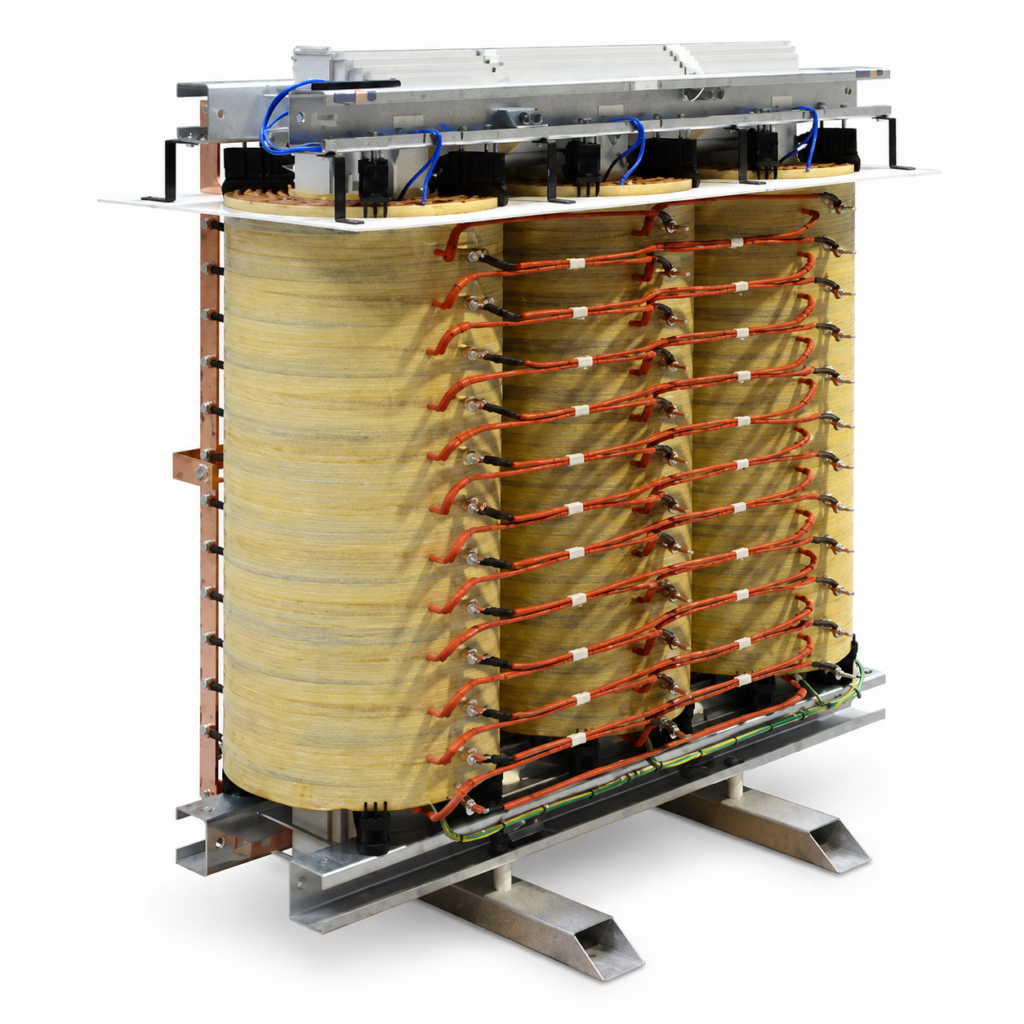
| Transformer Isolation | Galvanic isolation and voltage transformation configured around the input and output requirement |
| Voltage-Drop Compensation | Line voltage-drop compensation for long output cables or applications requiring controlled voltage at the load |
| Connectors and Terminations | Hard-wired terminals, IEC 60309 industrial connectors, MIL-standard connectors or customer-specified interfaces |
| Output Distribution | Single output, multiple protected branches or customer-specific distribution arrangements |
| External Metering | Energy metering, branch-circuit measurement or customer-selected external meters |
| Communication | RS232, RS485, Ethernet, Modbus, volt-free contacts and project-specific external I/O |
Choosing the Correct Connector
The connector should be selected from the electrical requirement first, not simply by physical size or appearance.
PX will normally review:
- Rated voltage and continuous current
- Single-phase or three-phase arrangement
- Number of power, neutral, earth and control contacts
- Cable conductor size and overall cable diameter
- Load inrush and short-duration current
- Frequency, including 400Hz operation
- Required locking or interlocking
- Number of expected mating cycles
- Indoor, outdoor or exposed use
- Connector ingress protection when mated and unmated
- Strain relief and cable support
- Prevention of incorrect connection through keying or coding
- Whether disconnection under load must be prevented
- Compatibility with existing site or aircraft equipment
- Hard-Wired Terminals
Hard-wired terminals are normally the most practical choice for permanently installed, higher-current SFC systems. They reduce connector limitations and allow the site cable to be selected around the actual current, installation method and voltage-drop requirement.
IEC 60309 Industrial Connectors
IEC 60309 connectors are widely used for industrial plug-and-socket applications. The current IEC 60309-1 standard covers industrial accessories with ratings up to 1,000V AC or DC, frequencies up to 500Hz and currents up to 800A, although the actual connector selected must still be checked against its manufacturer rating and the application.
MIL-Standard Circular Connectors
MIL-DTL-5015 covers circular threaded connectors used in electrical power and control circuits. Different classes provide different contact, sealing, fluid-resistance and environmental characteristics, so quoting “MIL connector” alone is not enough to define the required assembly.
Customer-Specified Connections
Where equipment already has a defined inlet or cable interface, PX can review the mating connector, pin allocation, cable specification and interlock requirements as part of the SFC configuration.
Enclosure and Installation Options
The enclosure must protect the SFC without preventing the airflow required to cool its power electronics and transformer.
A higher IP rating is not automatically the right answer. Improving protection against dust and water can restrict ventilation, increase enclosure size and require larger fans, heat exchangers or air-conditioning.
IEC 60529 defines the IP Code as a classification of enclosure protection against access, solid objects, dust and water. It does not by itself define protection against corrosion, salt spray, condensation, ultraviolet exposure, vibration or hazardous atmospheres.
Common PX Enclosure Ratings
| IP Rating | Typical Use | Practical Considerations |
|---|---|---|
| IP22 | Clean, dry indoor plant rooms, laboratories, workshops and controlled production areas | Provides the standard PX enclosure arrangement with effective ventilation. It is not intended for heavy dust, wash-down or direct exposure to rain. |
| IP32 | Indoor industrial areas requiring increased protection from falling debris and limited water exposure | Offers greater solid-object protection than IP22 while retaining a ventilated enclosure design. Site dust levels and water direction should still be reviewed. |
| IP54 | Dusty industrial areas, hangars, marine-related facilities and installations exposed to splashing water | Dust-protected rather than completely dust-tight. Cooling, condensation, cable entries and connector ratings require particular attention. |
| Special Enclosure | Outdoor, corrosive, high-temperature, high-altitude or project-specific installations | May require heaters, heat exchangers, air-conditioning, corrosion-resistant materials or additional environmental testing. |
PX currently lists IP22 as standard, with IP32, IP54 and special enclosure arrangements available according to the converter and installation.
Environmental and Installation Options
| Option | Purpose |
|---|---|
| Conformal Coating | Additional protection for selected PCBs in humid, dusty, corrosive or condensation-prone environments |
| Filtered Air Intake | Reduces the entry of airborne dust while maintaining forced-air cooling |
| Anti-Condensation Heating | May be considered where equipment is exposed to temperature cycling, high humidity or periods without internal heat generation |
| Enhanced Cooling | Higher-capacity fans, heat exchangers or conditioned cooling for increased ambient temperature or restricted ventilation |
| Fan and Temperature Monitoring | Provides additional warning of cooling-system or enclosure-temperature problems |
| Corrosion-Resistant Hardware | Suitable fixings, terminals and enclosure materials for humid, marine-related or corrosive locations |
| Alternative Cable Entry | Top, bottom, rear or customer-defined cable entry with suitable glands and terminal access |
| 19-Inch Rack Mounting | Integration of selected smaller SFCs into test racks, control cabinets or laboratory systems |
| Castors or Mobile Base | Allows the SFC to be moved between workshops, service bays or test locations |
| Towbar and Handling Arrangements | Suitable for larger mobile units used in hangars, production areas or ground-support environments |
| High-Altitude Configuration | Cooling and electrical clearances reviewed for operation above the standard rated altitude |
Choosing the Correct IP Rating
The assessment should consider more than whether the equipment is installed indoors or outdoors.
PX should be advised of:
- Dust type and concentration
- Water source and direction
- Cleaning or wash-down methods
- Indoor or outdoor location
- Shelter from direct rain
- Humidity and condensation
- Salt, chemical vapour or corrosive contamination
- Minimum and maximum ambient temperature
- Direct sunlight and solar heating
- Ventilation available around the SFC
- Altitude
- Cable-entry position
- Connector IP rating
- Whether doors are normally open during operation or maintenance
- Any hazardous-area classification
The enclosure IP rating applies to the complete assembled installation. Incorrect cable glands, open connector caps, poorly sealed entries or site modifications can reduce the effective level of protection.
400Hz and Aircraft Power Options
PX 400Hz Static Frequency Converters can be configured for aircraft ground power, avionics laboratories, MRO facilities, defence applications and production testing.
Typical aircraft outputs include 115/200V or 120/208V three-phase, four-wire at 400Hz, with combined 28V DC arrangements available on appropriate GPU systems.
| Option | Application |
|---|---|
| 400Hz Output | Three-phase aircraft and avionics power at the required line-to-line and line-to-neutral voltage |
| 28V DC Combined Output | Combined 400Hz AC and regulated 28V DC power from a single ground-power system |
| Aircraft Cable Assemblies | Output cables selected around current rating, cable length, flexibility and the required aircraft or test-equipment interface |
| Aircraft and MIL Connectors | MIL-standard, aircraft-standard or customer-defined connectors and pin arrangements |
| Line Voltage-Drop Compensation | Compensates for voltage drop along longer aircraft or avionics output cables |
| Remote Sensing | Allows the control system to reference voltage nearer the load where supported by the selected design |
| Output Interlocks | Customer-defined permissives, connector pilot contacts or external enable signals before output is energised |
| Mobile Ground-Power Construction | Castors, towbar, lifting points, cable storage and handling features for hangar or service-bay use |
| Fixed Hangar Installation | Floor-standing or wall-adjacent installation with fixed cable routing and local distribution |
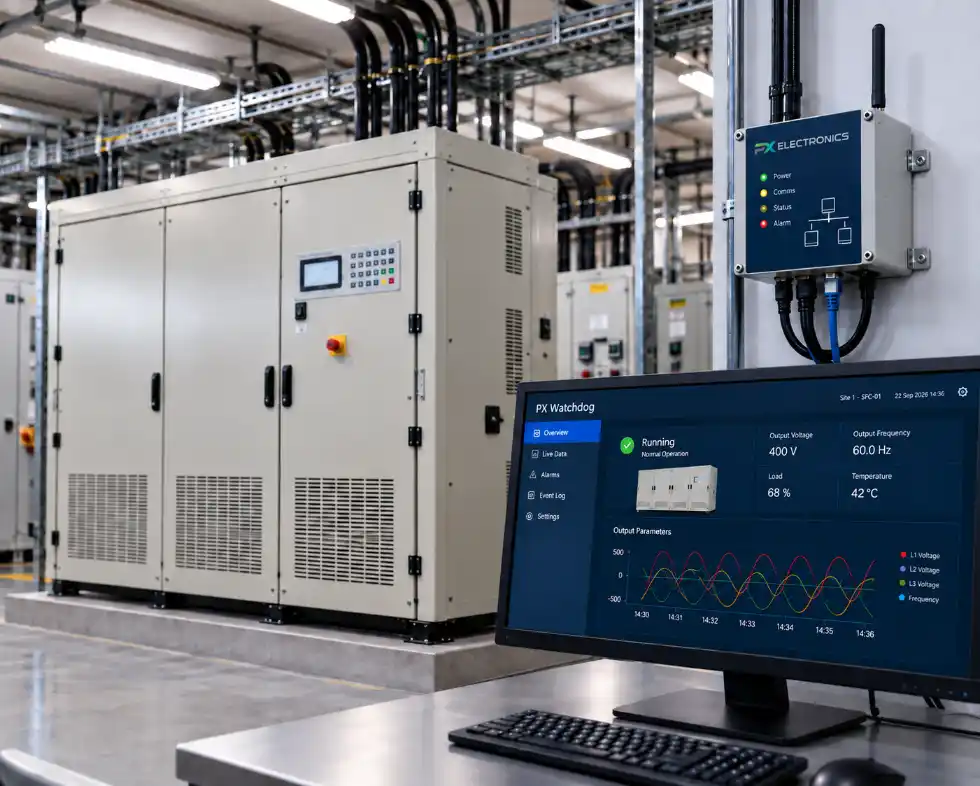
| SFC Remote Watchdog | Independent alarm monitoring, event history, remote notification and controlled restart options |
| Power Analysis and Metering | External metering or PA900 power analysis for voltage, current, power, harmonics and load behaviour |
| Factory Acceptance Testing | Customer-agreed load tests, protection checks, output verification and witness testing |
| Project Documentation | Certificates of Conformity, test records, drawings, cable schedules and operating documentation |
Cable Length and Voltage Drop
The output cable should be selected as part of the complete 400Hz power system.
PX will normally need:
- Required cable length
- Continuous load current
- Peak or inrush current
- Conductor cross-section
- Number of cores
- Cable flexibility
- Environmental exposure
- Connector type
- Permitted voltage at the aircraft or test load
- Whether line voltage-drop compensation is required
- Cable storage and handling arrangement
Long cable runs should not be added after the SFC has been specified without checking voltage drop, conductor heating and the available compensation range.
No matching FAQs found.
Options can include alternative input and output voltages, phase arrangements, 50Hz, 60Hz or 400Hz output, higher IP ratings, conformal coating, remote communications, SFC watchdog monitoring, industrial connectors, aircraft cables, mobile construction and factory testing.
Availability depends on the converter series, rating and application.
IP22 is generally suitable for clean, dry indoor areas. IP32 provides increased protection for indoor industrial locations. IP54 is more appropriate where dust or splashing water may be present.
The correct choice depends on the actual installation, cooling requirement and environmental exposure rather than the location description alone.
Not automatically.
IP54 addresses dust and splashing-water ingress, but it does not by itself address condensation, corrosion, salt spray, direct sunlight, ultraviolet exposure, extreme temperature or wind-driven rain. Outdoor use requires a review of the full environment and installation method.
Start with the voltage, current, phase arrangement, neutral and protective-earth requirements. Then consider cable size, connector locking, expected mating cycles, environmental exposure, IP rating, strain relief and compatibility with the connected equipment.
A connector should not be selected from current rating alone. Contact arrangement, operating frequency, cable diameter, temperature and whether it can be disconnected under load are also important.
Common options include aircraft cable assemblies, appropriate connectors, line voltage-drop compensation, output interlocks, mobile construction, cable storage, remote monitoring, external metering and combined 28V DC output.
The cable length, load current and required voltage at the aircraft should be provided before the system is specified.
Yes. Depending on the SFC, options can include RS232, RS485, Ethernet, Modbus, volt-free contacts, digital I/O and the PX SFC Remote Watchdog.
The required commands, alarm signals, network arrangements and remote-control permissions should be agreed before manufacture.
Consider dust, water direction, cleaning methods, humidity, condensation, temperature, corrosion, salt, ventilation, cable entries and the IP rating of fitted connectors.
A high IP rating can also reduce natural airflow, so the cooling system and enclosure size may need to change.
Conformal coating should be considered for humid, dusty, corrosive or condensation-prone environments.
It adds protection to selected electronic assemblies, but it does not replace the need for a correctly specified enclosure, filtered cooling and suitable maintenance. PX lists conformal coating as an available option for harsh or humid applications.
Hard-wired terminals are normally preferable for permanently installed and higher-current SFC systems.
They allow the installation cable to be sized around the actual current, voltage drop and site wiring method without introducing the current, contact-resistance or physical limitations of a detachable connector.
Some external accessories may be added later, but major items are best specified when the SFC is ordered.
Enclosure rating, transformer arrangement, output neutral, internal switchgear, connectors, cable entry, harmonic mitigation and cooling changes may require substantial redesign. Retrofit suitability must therefore be reviewed individually.